

Saturday, January 25, 2014


Friday, January 24, 2014
The K-9 handler's arch nemesis—distractions: How to deal with noises and objects that spook or attract a working K-9, by Jeff Schettler
 |
| The
author working K-9 Anvak through tractor/trailer engine-noise fear. |
I have often heard handlers tell me that their dog has a certain attraction or fear reaction to a certain "thing," and they take it for granted that it is a problem. Rather than trying to fix it, they attempt to avoid the problem or let the problem shut the dog down.
This is a bad habit and does nothing more than reinforce the reaction in the dog. If the dog realizes that the handler will give in to an attraction or give up when the dog encounters something about which he is nervous, the distraction becomes stronger each and every time this happens.
There will come a point at which the handler may not be able to correct it. As with the kitty, the attraction or phobic response should be dealt with immediately and never be reinforced by allowance.
The only way I learn about a dog's attraction or phobic response to an animal or object is through his body language. There is no other way, because the dog cannot speak to me. I am charged with the duty to be cognizant of what affects the dog. My job is that of an interpreter, motivator, and leader.
Ronin was my first dog, and he was wonderful for me because he provided the basis for everything I did then and for what I am now. I am now intensely watchful of any dog's body language at all times that I am with him. If the dog is for work, I am doubly watchful.
The only way I learn about a dog's attraction or phobic response to an animal or object is through his body language. There is no other way, because the dog cannot speak to me. I am charged with the duty to be cognizant of what affects the dog. My job is that of an interpreter, motivator, and leader.
 |
| Training a police K-9 puppy to not be concerned with gunshots. |
- First, I needed to make my dog realize that I was not afraid. I am the perceived leader, and if the dog thinks that I am afraid based on my odor or physical reaction, his reaction will be equal to or exceed my own.
With my behavior, I affect what and how my dog responds to situations. If I am a rock in a stormy sea of stimuli, my dog will be easier to deal with. I showed Ronin that I was not afraid; I approached the truck confidently and with no hesitation. - Second, I used motivation and reward (food) to coax him in close. This took time, but I got Ronin to the point that he could trail right past a trash truck and not give it a second glance. The reward can be anything the dog likes such as a ball, tug, or praise. Ronin was a walking stomach, and food was the key to everything.
 |
| Training a police K-9 puppy to not be concerned with gunshots. |
What I mean by coddling is, when the dog shows a fear reaction, the handler reaches down and pets and fawns over him, cooing sweet nothings into his ear.
This behavior reinforces the fear because, in reality, the petting and cooing are telling the dog that he is right to be afraid of what he is balking at.
Dogs are not children, and they do not rationalize things the way people do; stroking and "rewarding" fear behavior tells the dog that his fear behavior is well founded.
The best way for a handler to correct his dog is to firmly say "no," confidently walk up to the "thing," inspect it with no fear, and then motivate his dog to come over. If it takes six months to fix this situation, so be it.
Source: This article was adapted from K-9 Trailing—The Straightest Path, by Jeff Schettler. Copyright © 2011 by Jeffrey Hampton Schettler. Alpine Publications, Inc. All Rights Reserved. Excerpted with Expressed Written Permission. To order your copy of this book—which was written by a man-hunter for man-hunters— point your Internet browser to the Georgia K9 National Training Center.
Jeff Schettler is a retired police K9 handler who worked for the City of Alameda and County of Amador in California, and was attached to the FBI’s Hostage Rescue Teams’ K9 Assistance Program for two years. This program was designed to locate and apprehend high-risk fugitives on the run.
Jeff has worked hundreds of trailing cases across the USA and is a specialist in the area of tactical trailing applications. He and his police bloodhound, Ronin, made numerous successful finds during their 11-year career.
Jeff has trained under many well-known manhunters, including Jerry Yelk, Glenn Rimbey, Jerry Nichols, John Lutenberg, John Salem, and Doug Lowry.
Jeff is considered a law enforcement expert witness in the areas of scent evidence and trailing with bloodhounds. He has qualified as an expert in the counties of Santa Clara and Alameda in California. He has also corroborated other police K9 handlers in court with regard to their trailing training and experience.
After leaving the police force, Jeff founded TacticalTrackerTeams.com and later integrated it with the Georgia K9 National Training Center, LLC, with his partner Kelli Collins.
Georgia K9 National Training Center is a specialty K9 training company with nationally recognized dog trainers and clients across the country. GAK9 offers a variety of services, each tailored to fit the needs of civilian, law enforcement, and search & rescue dog owners and handlers.
Jeff rarely relaxes at his home/dog training facility in Canton, Georgia; there are just too many dogs running around.
He has recently expanded his K9 horizons and began training Basenjis to find narcotics and explosives. His series of nine articles called the “Hunter Basenji Chronicles,” covering the use of the Basenji for hunting and detector dog work, were published in the Basenji Magazine.
To schedule training, or learn more about the Georgia K9 National Training Center—which has offices in Georgia, South Carolina, and Virginia—point your Internet browser here.
• Follow Georgia K-9 on Facebook.


Aircraft Accident Investigation Board (AAIB) finding: fatal fall during heli hoist operation was caused by improper harness attachment

The accident occurred approximately 30 miles east of Visalia, California, on 12 September 2013....read more here.
Wednesday, January 22, 2014
Standard belay devices and their loading-handling capabilities, by Richard Delaney

Notes: The "hand" applied tension was an attempt to apply a tension similar to what could normally be applied with one hand on the rope, and the other hand at one's side—as if behind a belay device when belaying/abseiling/rappelling. The"max" applied tension was an attempt to apply a tension similar to what could normally be applied holding the belay rope with two hands, standing behind the device with good footing. Richard also measured these subjective approximations and got 10kg for one hand, 10-20kg for two hands at the waist height behind a device, and 50kg for the max/two hands standing pulling out in front effort. He used 11mm Edelrid super static rope, says all "figures should be viewed as +/- 20kg or so," and described the test process as an "example of experimentation and interpretation."
 |
| The setup Richard used for this test. |
Source: This article was adapted from Standard belay devices and their loading-handling capabilities, by Richard Delaney, Copyright © 2014. All Rights Reserved. Excerpted with expressed written permission. To learn more about rope access work, climbing, and rope rescue, visit Richard's Rope Test Lab.
Richard Delaney has worked professionally with ropes since 1992. Initially, this was as a multi-pitch, rock-climbing guide, but this soon morphed into specialized rescue instruction and rope access work.
He is currently an accredited Vertical Rescue Instructor/Assessor, a Level 3 Rope Access Technician, a Technical Director of the Australian Rope Access Association, and the administrator of the Rope Test Lab group on Facebook.
Understanding and teaching the Physics of Rigging is a core passion of Richard's, one based on his experience, and his prior professional life as a qualified engineer.


• To follow Richard on Facebook, 'like' the Rope Test Lab group page.
Tuesday, January 21, 2014

RECALL: RescYou Crevasse Rescue Device recalled by Mammut


Monday, January 20, 2014
Montana SAR volunteer killed in a snowmobile accident during training

A Libby Search & Rescue volunteer [DTSAR Team Web site] was killed in a snowmobile accident Saturday morning southwest of Troy.
On Saturday, January 18, 2014, members of David Thompson Search and Rescue and CANAM Search and Rescue were taking part in a joint avalanche preparedness training exercise in the Bear Mountain area up Keeler Creek, about 12 miles southwest of Troy, Montana. This joint training also involved members of search and rescue teams from Sanders County, Montana and Boundary County, Idaho, along with personnel from the U.S. Forest Service and other volunteer members of the community.
At about 9:50 AM, Troy Dispatch was advised of a snowmobile accident on the Keeler Creek road, with one male adult victim. Medically trained personnel already at the scene of the accident requested an air ambulance response and began CPR on the patient. The Alert Helicopter out of Kalispell was launched to respond. Troy Volunteer Ambulance (TVA) and Advance Life Support (ALS) personnel responded to the scene from Troy.
Upon arrival at the trailhead parking area, an ALS member was transported up the drainage by snowmobile to meet the patient. The patient, identified as Cameron Mitchell Goins, age 47, of Libby, was declared dead at 10:33 AM, shortly after ALS arrival. The helicopter response was cancelled.

The accident investigation revealed that Goins, along with a group of other snowmobilers, was riding his snowmobile alone up the Keeler Creek drainage toward the avalanche training area when, for an unknown reason, Goins drifted off the maintained snowmobile trail and struck a tree with his body. Goins was wearing a helmet.
Goins had been a member of David Thompson Search and Rescue for two years. He was an active member of the Snowmobile Unit, ATV Unit, and Mountain Unit.
“Cameron Goins was a dedicated community volunteer and will always be remembered and have a place within David Thompson Search and Rescue, and the Lincoln County Sheriff's Office. Our heartfelt sympathies go out to his family.” - Sheriff Roby Bowe.
 Sources: NBC Montana, JoCoSAR Blog
Free pocket-sized 'Track Card' for man-tracking field notes
Download and print this free Track Card—courtesy of Fernando Moreira, Professional Tracking Services, Reno, Nevada—here.

Source: This article was adapted from man-tracking course material provided by Fernando Moreira of Professional Tracking Services in Reno, Nevada. Copyright © 2014. All Rights Reserved. Excerpted with expressed written permission.
Fernando Moreira has been involved in man-tracking for over 40 years. He learned the art of tracking in Portugal, from his father—a Portuguese Combat Tracker—as well as from African bushmen, the Rhodesian military, and his four years with the Portuguese Army, where he served as a combat tracker during the African wars in Mozambique, Guinea, and Angola.
Fernando is a long-time member of several search and rescue units, including the Washoe County Sheriff’s Hasty Team and Washoe County Search & Rescue, Inc. His certifications include PSD Diver, Swift Water Rescuer, Back Country, SAR Tech II, Technical Rope, and Mine Rescue. He has been a State of Nevada-certified tracking instructor since 1997, and is a Nevada State P.O.S.T.-certified investigative tracker and instructor.
In addition to working on over 15,000 man-tracking cases—the longest of which was 46 miles!—Fernando has assisted local law enforcement officers in numerous manhunts for felons and searches for critical evidence in several high-profile investigations, including bank robberies, child molestations, and murders, most notably, the case against Siaosi Vanisi, who brutally murdered campus police officer George Daniel Sullivan in 1997. Fernando has received numerous awards, citations, and letters of merit, including: two-time recipient of the American Red Cross Real Hero Award; Rescuer of the Year; Excellence in Search and Rescue Medal, etc. He was nominated twice for America’s Most Wanted All Star Award
As the founder of both the Tactical Tracking School and Professional Tracking Services in Reno, Nevada, Fernando has taught over 5,000 military combat man-trackers, law enforcement tactical man-trackers, and search-and-rescue man-trackers across the United States and the world. To learn more about Fernando's man-tracking career, read "America’s Most Wanted: Staying on Track and Learning from the Best," which appeared in the Spring, 2008 issue of the Forensic Examiner.
• Fernando's Tactical Tracking School: Web site
• Fernando's Professional Tracking Services: Web site; Facebook Page No 1, No. 2
• Follow Fernando on Facebook: Personal Page; Tactical Tracking Group Page
Sunday, January 19, 2014
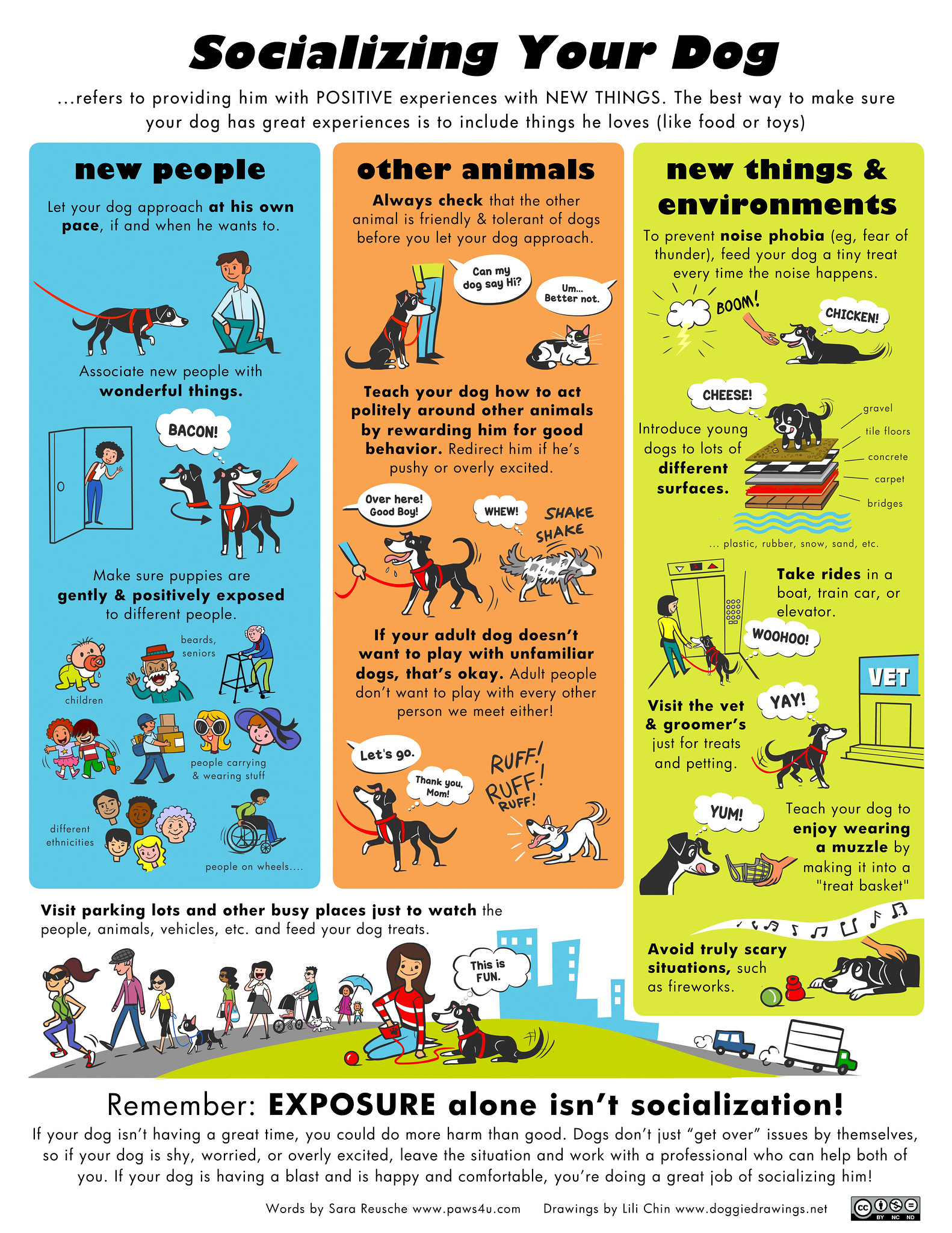
How to socialize a K-9


View high-resolution image of this info graphic here.
Info graphic courtesy of Doggie Drawings by Lili Chin. Copyright © 2014. All Rights Reserved. Reproduced With Permission.
.
Turn your Android or iPhone into a satellite smartphone with the SatSleeve from Thuraya
 SatSleeve for Android phones
The perfect blend of mobility and simplicity, the Thuraya SatSleeve is the smartest, fastest and simplest way to transform your Android phone into a satellite smartphone.
Thuraya SatSleeve provides access to phone calls, emails, instant messages and popular social media apps in satellite mode across 160 countries within Thuraya’s coverage network....More info
 SatSleeve for iPhones
The perfect blend of mobility and simplicity, the Thuraya SatSleeve is the smartest, fastest and simplest way to transform your iPhone into a satellite smartphone. An industry first, the
Thuraya SatSleeve provides access to phone calls, emails, instant messages and popular social media apps in satellite mode, across 159 countries across Thuraya’s coverage network...More info
9-volt-battery fire hazard

The resident had just cleaned and organized a junk drawer in her kitchen and the fire was started by storing the 9 volt battery in the same baggie as other batteries, the state fire marshal's office said in a press release.
The 9 volt battery rubbed against another battery and ignited the fire, according to the investigation by the local fire department. Read more here.
Source: Watch video on the JoCoSAR Blog
Saturday, January 18, 2014
Heli rescue video on Mt. Lemmon, January 11, 2014, by Pima County Sheriff's Department Air Rescue, Tucson, Arizona

Source: JoCoSAR Blog
Wilderness First Aid—Is it helpful to put a warm person into a sleeping bag with a cold, hypothermic person? By Tod Schimelpfenig, NOLS Wilderness Medical Institute
 |
| Photo credit: © Josh Whitmore/NOLS |
Actually, snuggling may not be the best word, because putting aside the giggles this conversation elicits in some audiences it’s not easy to hug a physically cold person and the snuggling is a necessary task, not a recreational experience.
But, that’s not what I want to write about. I want to discuss whether it’s helpful to put a warm person into a sleeping bag with a cold person.
Source: This article was adapted from Hypothermia—Two People in a Sleeping Bag, by Tod Schimelpfenig, EMT, FAWM, Curriculum Director, Wilderness Medicine Institute (WMI). Copyright © 2014 National Outdoor Leadership School (NOLS), Lander, Wyoming. All Rights Reserved. Excerpted with expressed written permission. To learn more about WMI and NOLS, point your Internet browser here.

Body-to-body warming hasn’t seen much research. It seems the technology of heaters and forced air warming is more attractive. The research we found says it doesn’t help much, and it probably doesn’t harm. [1] [2]
According to Gordon Giesbrecht an adult cooled to 95 degrees F (34.7 degrees C), the common threshold for hypothermia definitions, can have a profound caloric deficit. [2] A healthy adult at rest will make about 1kcal of heat per kg of body weight per hour. This won’t be enough to quickly reverse significant hypothermia. In those tales where we got in a sleeping bag and heroically warmed the severely cold person — well — we may have done the patient a favor, but they probably were not very cold in the first place.
 |
| Photo: Marcio Paes Baretto, Wyss Wilderness Medicine Campus |
According to Dr Giesbrecht [3] the transfer of the energy to the core will be blunted by vasoconstriction. Since most of our mildly hypothermic patients are not dramatically vasoconstricted, this will be only a small hindrance. In severely hypothermic patients it may be a significant limitation to the heat transfer from donor to recipient.
We know that shivering is a powerful means, indeed our best wilderness tool to produce heat in a person with the energy reserves to shiver. We also know that warming the skin blunts the shivering response. We don’t know the significance of the shivering inhibition from warming skin because, even if the patient shivers less, they feel more comfortable and preserve their energy reserves (e.g. they burn fewer calories shivering).
There is concern the donor may become hypothermic. I’ve seen heat donors realize this isn’t a lot of fun, but in the real world, and in the research, the donors don’t become hypothermic.
What are the positives of putting another person in the bag?
- It may provide comfort for the patient to snuggle with another person.
- You can monitor the patient closely.
- You may help the patient warm while they expend fewer calories shivering.
- If the patient is unable to shiver, perhaps they are severely cold, metabolically exhausted, or unable to shiver, the second person in the bag may at least warm the insulation, the thermos bottle of the hypo wrap, and help keep the patient from cooling further, a very important goal.
- You may not be able to fit the heat donor in the bag and still close the opening tightly. This may reduce the effectiveness of the hypo wrap.
- If you plan on carrying the patient with the heat donor inside you’ll have the weight of two to manage.
- The donor may jostle the severely cold patient, who we want to treat as gently as possible.
- The heat donor is not on the surface doing important tasks such as building a fire, making sure your companions are also not hypothermic, or preparing shelter, hot drinks and food.
- When the heat donor has tired of being in the wrap and wants out the nice cocoon has to be opened.
What should we do?
Most of our “hypothermic” patients in the wilderness are not hypothermic in a medical sense, that is, they are warmer than 95F (34.7C).
The people we think of as hypothermic are cold challenged, cold stressed, cold and unhappy. However, our world is not the controlled hospital environment. This situation gets our immediate attention. We’ll attend to the cold person promptly, and if they are healthy, we’ll warm them by removing them from the cold stress, placing them in dry clothing and dry insulation, such as a sleeping bag, and feeding and hydrating them. Their internal metabolic fires, shivering, and our tender loving care will warm their heart, and their body.
People who are truly hypothermic are dangerously ill. They may be wasted (a non-medical term that says they are fatigued, dehydrated and low on food reserves), or have a serious simultaneous medical condition. We may not be able to warm these people in the backcountry. Our efforts are focused on stabilizing the patient; we don’t want to jostle them or allow them to cool further. They likely will only warm in the hospital, so we transport them gently.
I’ve been told two people in a sleeping bag to treat hypothermia is the “standard of care” in the wilderness. Actually, it’s not. The science isn’t strongly in it’s favor and in the wilderness, scenarios are often unique, our equipment less than ideal and our need to improvise real. As always, we’ll use our judgment, understand the principles of treatment and weight the factors in our specific scenario.
The heat sources you have available on your wilderness trip may only be insulated hot water bottles, or the patient’s metabolism and shivering. If you have a good camp and plenty of people you may be able to spare a person to be in the sleeping bag. If you’re a small group, and knowing heat transfer between bodies is not very efficient, you may decide your assistant is best used staring a fire, making a warm meal and drink on the stove, setting up the camp or attending to the other people on your trip.
_______________
1. Harnett RM, O’Brien EM, Sias FR, Pruitt JR. "Initial treatment of profound accidental hypothermia." Aviat Space Environ Med. 1980;51:680–687.
2. Giesbrecht GG, Sessler DI, Mekjavic IB, Schroeder M, Bristow GK. "Treatment of mild immersion hypothermia by direct body-to-body contact." J Appl Physiol. 1994;76: 2373–2379.
3. Hypothermia, Frostbite and other Cold Injuries. 2ed Giesbrecht GG and Wilkerson JA. The Mountaineers. 2007.
Friday, January 17, 2014
6 ways to more effectively manage a search incident

- Keep operational periods to 12 hours or less
- Span of control should not exceed 7
- Make decisions using consensus and consultation
- Be proactive, not reactive
- Manage resources effectively
- Use common terminology
Source: This article was adapted from Arizona Basic Search and Rescue, 2nd edition (February 2013), by the Arizona Search and Rescue Coordinators Association, Ltd., in Hereford, Arizona, USA. Copyright © 2014. All Rights Reserved. Excerpted with expressed written permission. To learn more about search and rescue in Arizona, point your Internet browser to SARAZ.org.

Keep operational periods to 12 hours or less
The number of hours for which search managers can remain effective, rational decision-makers is limited. Normally, the quality of thinking processes begins to wane after 8 hours of duty and becomes severely impaired after 12 hours. The usual full operational period therefore consists of 12-hour shifts, with an overlap of approximately one hour at shift changes so that the next overhead team can be adequately briefed. In other words, the work shift is longer than the Operational Period.
In urban searches the Operational Period is sometimes set at 8 hours, rather than 12. The start and length of the second and subsequent operational periods should be proposed by the Planning Section, confirmed by the Logistics Section, and given final approval by the Incident Commander. The operational period is the period of time scheduled for completion of a given set of actions called for in the IAP.
Span of control should not exceed 7
The number of people that a manager can effectively supervise is limited, especially during a SAR incident. ICS recommends that the number of supervised people is between 3 and 7, with 5 suggested as an optimum.
When the number becomes larger than this, it is time to delegate authority to assistants, to whom the manageable span of control also applies. The size of the current organization and that for the next operational period are determined through the incident planning process.
Make decisions using consensus and consultation
In search management, the basic tenet is "Never Plan Alone". Consultation requires discussion, and discussion facilitates a rational and systematic approach to search planning, where ideas are analyzed and reevaluated through dialogue.
For example, although the Incident Commander has sole responsibility for establishing the incident objectives, they consult with members of the overhead team before doing so. Similarly, the Planning Section Chief draws upon all available expertise when assigning priorities to different segments of the search area.
Be proactive, not reactive
A proactive search manager anticipates events before they occur and is fully prepared to cope with emerging problems or difficulties. Bad weather, injuries, accidents, equipment failures, and the depletion of resources are planned for rather than merely reacted to.
Most importantly, search managers must have at their disposal a preplan, which guides many of the decisions that have to be made during a search emergency. A good preplan anticipates such problems and suggests optimal courses of action for each.
Manage resources effectively
Resources at an incident must be managed effectively. Maintaining an accurate and up-to-date picture of resource utilization is a critical component of incident management. Resource management includes processes for:
- Ordering resources.
- Dispatching resources.
- Categorizing resources. For example, there are three ways to temporarily organize resources: as single resources, as strike teams, or as task forces.
- Single Resources. As the name implies, a single resource is an individual piece of equipment, or group of individuals, with an identified supervisor. Examples of a single resource are: a helicopter with pilot, an air scent dog with handler, a UAV with "pilot", an ATV with driver, a hasty search team with leader.
- Strike Teams. A strike team consists of resources of the same kind with common communications and a leader. Examples of a strike team are: an 8-man team created from four 2-man hasty teams to search a segment, or two horses and their riders.
- Task Forces. A task force consists of resources of different kinds with common communications and a leader. An example of a task force is an air-scent dog and handler together with an additional person to handle communications.
- Tracking resources. The status of a resource that is checked-in but not checked out, fall into one of three categories.
- Assigned. Currently working on an assignment under the direction of a supervisor.
- Available. Ready for immediate assignment and has been issued all required equipment.
- Out-of-Service. Neither available nor ready to be assigned (for example, maintenance issues, rest periods).
Use common terminology
For effective management, everyone must speak the same language. A number of central terms basic to ICS have already been introduced, such as "Incident Commander" and "Operational Period". Others follow.
- Position Titles. At each level within the ICS organization, individuals with primary responsibility have distinct titles, as do their assistants. See Table 12.1. Titles provide a common standard for all users, and also make it easier to fill ICS positions with qualified personnel. ICS titles often do not correspond to the titles used on a daily basis.

- Incident Facilities. Common terminology is used to designate the facilities in the vicinity of the incident area that are used in the course of incident management activities. See Figure 12.2. These include
- Incident Command Post (ICP), where the Incident Commander oversees the incident.
- Staging Areas, where resources are kept while waiting to be assigned.
- Base, where primary logistics functions are coordinated and administered.
- Camps, where resources may be kept.
- Helibase/Helispot, where helicopter operations are conducted.
The terms "base camp" and "rendezvous" which are sometimes used in SAR, are not in the ICS vocabulary, and their use should be discouraged.

- Resource Descriptions. Major resources—including personnel, facilities, and major equipment and supply items—used to support incident management activities are given common names and are "typed" with respect to their capabilities, to help avoid confusion. ICS identities resources as tactical or support resources.
- Tactical Resources. Personnel and major items of equipment used in the operation.
- Support Resources. All other resources required to support the incident (for example, food, communications equipment, supplies).
In English, the expressions "type of resource" and "kind of resource" could be used interchangeably. Not so under ICS. The word "Kind" describes what the resource is, while the word "Type" describes its capability. For example, a helicopter is a kind of resource. - Divisions and Groups are ways of partitioning an incident into manageable pieces. A Division is a geographical region established using boundaries. For example, if there were 12 regions to search, that exceeds the span of control, then the search area could be divided into two Divisions, called Division A and Division B, each containing 6 regions. A Group is a collection of people established by function, that is, what it does. For example, the Medical Group consists of the following people, or the Investigative Group consists of the following people.
- SAR Buzzwords. More specific to SAR are the following important words that everyone involved with the management of a SAR incident should understand: Place Last Seen (PLS), Last Known Position (LKP), Initial Planning Point (IPP), Consensus, Probability of Area (POA), Rest of the World (ROW), Probability of Detection (POD), and Cumulative Probability of Detection (CPOD).
- Plain Language. The use of plain language, rather than 10-codes, in an emergency response is the ICS norm.

To learn more about ICS protocols, point your Internet browser here.

Thursday, January 16, 2014
Mountain rescue team members—'The Lone Wolves'
 |
| Author Benjamin A. Gochberg, Vail Mountain Rescue Group (VMRG) |
It was nearly Christmas, and we were
grateful it had been a relatively quiet rescue season thus far.
The Vail
Mountain Rescue Group had decided to hold a party at one of our
members’ home.
Watching mountain men, ex-Marines, river runners, guides,
patrollers, paramedics, truckers and, yes, even the one-off CPA, pastor
or banker crowd into a single kitchen can be quite an interesting
experience.
Mountain Rescue was once described to me
as an organization made up entirely of lone wolves. This is damn
accurate.
It requires strong personalities and strong will to step into
some parts of the backcountry — a will that must often be used for less
romantic purposes, like holding your tongue when you want to speak, or
standing in the rain waiting for your next set of instructions, or
hiking in 12 miles to the backside of Holy Cross to save unwise people
that believe you are obligated to come get them.
I’m proud to stand among these lone wolves on this particular night,...read more here.
 Source: Mountain Rescue Association
Ice-safety guidelines

- 2" or less — STAY OFF
- 4" — Ice fishing or other activities on foot
- 5" — Snowmobile or ATV
- 8" to 12" — Car or small pickup
- 12" to 15" — Medium truck

More ice-safety info:
- Ice thickness guideline
- Traveling on ice
- Survival plan
- Ice rescue claws: making and using
- Vehicle escape
- Helping someone else
- 28-page Hypothermia brochure
- 2-page Danger Thin Ice brochure
- 30-second ice-safety radio PSA
- 31-minute ice-safety podcast


Wednesday, January 15, 2014

Theoretical vs. Practical Mechanical Advantage, by Richard Delaney
 To read the exchange of comments, questions, and answers between the author of this graphic and other rope enthusiasts on the Rope Test Page, point your Internet browser here.
Richard Delaney Source: This article was adapted from Theoretical vs. Practical Mechanical Advantage, by Richard Delaney, Copyright © 2014. All Rights Reserved. Excerpted with expressed written permission. To learn more about rope access work, climbing, and rope rescue, visit Richard's Rope Test Lab.
Richard Delaney has worked professionally with ropes since 1992. Initially, this was as a multi-pitch, rock-climbing guide, but this soon morphed into specialized rescue instruction and rope access work.
He is currently an accredited Vertical Rescue Instructor/Assessor, a Level 3 Rope Access Technician, a Technical Director of the Australian Rope Access Association, and the administrator of the Rope Test Lab group on Facebook.
Understanding and teaching the Physics of Rigging is a core passion of Richard's, one based on his experience, and his prior professional life as a qualified engineer.



Subscribe to:
Posts (Atom)